
As PCB assemblies become denser and component packages become smaller, repairing a defective BGA is no longer a simple soldering task. Ball Grid Array packages place solder connections underneath the component, making the joints inaccessible to conventional soldering tools.
For electronics manufacturers, EMS providers, and repair centers, effective BGA reworking requires controlled heating, accurate component positioning, repeatable process parameters, and appropriate inspection. A professional BGA system can help recover valuable PCBAs while reducing scrap and maintaining production quality.
Seamark ZM provides BGA rework solutions covering manual, semi-automatic, and fully automatic configurations, allowing manufacturers to select equipment according to board size, component type, repair volume, and required process precision.
BGA technology provides high interconnection density and supports compact electronic designs, but its hidden solder joints create significant challenges during repair.
A successful ball grid array rework process must control several variables simultaneously:
PCB preheating
Top-side heating
Temperature distribution
Solder melting and reflow
Component alignment
Placement force
Cooling rate
Protection of nearby components
If heating is excessive or uneven, the PCB can warp or nearby components may be affected. If alignment is inaccurate, solder balls may not correspond correctly with the PCB pads. These problems can create intermittent electrical failures even when the repaired board appears visually acceptable.
This is why industrial rework should be treated as a controlled manufacturing process rather than simply a repair operation.
Among the most important technologies in modern BGA rework systems is multi-zone thermal control.
A typical system uses bottom preheating to gradually raise the PCB temperature while applying localized heat from the top. This reduces the temperature difference across the board and helps limit thermal stress.
Different packages also require different thermal profiles. A large BGA on a multilayer server board does not respond to heat in the same way as a small component on a mobile PCB.
Seamark's BGA equipment portfolio includes systems using infrared and hot-air heating technologies, as well as configurations with multiple independent heating zones. Its ZM-R7220A, for example, is an infrared soldering station with three independent heating zones and temperature monitoring capabilities.
For production engineering teams, the objective should be repeatable thermal performance rather than simply reaching solder reflow temperature.
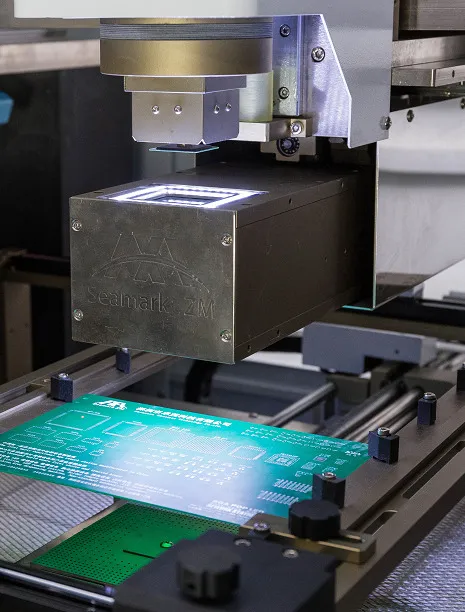
Thermal control alone cannot guarantee a successful repair. Accurate placement is equally important.
Modern BGA rework stations may incorporate CCD-based optical alignment systems that allow the operator or machine to align the BGA component with the corresponding PCB pads before placement.
Optical alignment becomes particularly valuable for fine-pitch packages, high-pin-count devices, and densely populated boards. Instead of relying solely on mechanical references, the system can use images of the component and PCB to improve positioning.
Seamark ZM's higher-end BGA systems incorporate high-definition visual alignment. The manufacturer states that certain systems can achieve repeat placement accuracy of up to ±0.01 mm, although actual results depend on equipment configuration, component characteristics, and operating conditions.
This level of positioning control is especially relevant to server boards, communication equipment, automotive electronics, and other high-value PCBAs.
There is no universal “best BGA rework station.” The appropriate configuration depends on production requirements.
Manual systems can be suitable for laboratories, low-volume repair, prototypes, and straightforward PCB work. They generally require experienced technicians to control alignment and process parameters.
Semi-automatic systems provide a balance between operator involvement and process consistency. They are suitable for repair departments and medium-volume PCBA production where flexibility remains important.
BGA rework station automatic configurations are designed for applications where repeatability, throughput, and process standardization are priorities. Automated alignment, placement, heating, and process control can reduce operator-dependent variation.
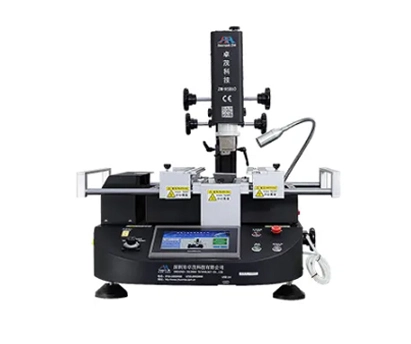
Seamark ZM offers examples across these categories, including the manual ZM-R5860, semi-automatic ZM-R7220A, and fully automatic ZM-R8650C. The manufacturer positions different models for applications ranging from basic PCBA repair to large server and 5G communication boards.
The value of professional BGA repair station technology becomes particularly clear when the PCB itself is expensive or difficult to replace.
Engine control units, infotainment systems, ADAS electronics, and other automotive modules can contain densely populated PCBAs. Controlled BGA rework can help manufacturers repair defective assemblies while maintaining documented process conditions.
For automotive applications, repair procedures should be validated against customer requirements and applicable quality systems rather than relying solely on equipment specifications.
Large communication boards and server motherboards often contain high-value processors and BGA packages. Discarding an entire board because of one defective component can create substantial material and downtime costs.
Large-board rework systems are therefore useful where board size, thermal uniformity, and component positioning present additional engineering challenges.
Smartphones, tablets, gaming systems, and other compact products frequently use BGA, CSP, QFN, and miniature components. A flexible rework platform can support repair operations across multiple package sizes.
Seamark states that its BGA equipment can be used for BGA, CSP, POP, PTH, WLCSP, QFN, 0201/01005 components, shielding frames, and modules on various PCBA platforms.
Industrial control equipment, medical electronics, aerospace-related systems, and other high-reliability products require greater process discipline. Rework should be performed according to documented procedures, with inspection and traceability appropriate to the product's risk level.
A major difference between professional and improvised rework is process documentation.
Manufacturers should establish approved profiles for different package types, PCB constructions, and solder alloys. Temperature measurements, equipment calibration, operator training, and maintenance should also form part of the quality system.
IPC J-STD-001J emphasizes process control for producing soldered electrical and electronic assemblies and establishes requirements for materials, processes, and acceptance. It also distinguishes product classes according to intended end use and reliability requirements.
IPC-A-610 provides acceptance criteria for completed electronic assemblies. When these standards are referenced contractually, manufacturers should ensure that their rework and inspection procedures are consistent with the applicable requirements and customer documentation.
For rework-specific procedures, manufacturers may also need to consider applicable IPC rework and repair documentation, customer specifications, and internal quality procedures.
Reflow completion does not automatically mean that a BGA repair is successful. Because solder joints remain hidden underneath the package, additional inspection may be required for high-reliability applications.
This is where BGA X-ray inspection can complement the rework process. X-ray inspection can provide visibility into hidden solder connections and help identify issues that cannot be confirmed through ordinary visual inspection.
A typical quality workflow can therefore be:
BGA defect identification → component removal → pad preparation → optical alignment → controlled reflow → cooling → post-rework inspection → functional verification.
The inspection method should be selected according to the defect risk and customer requirements. Seamark ZM also provides microfocus X-ray inspection equipment alongside its BGA rework systems, enabling manufacturers to consider repair and inspection as connected parts of a broader PCBA quality strategy.
When evaluating a rework machine, purchasing teams should assess the complete process rather than focusing on one specification.
Key questions include:
What PCB sizes can the system accommodate?
Is bottom preheating available?
How many heating zones are independently controlled?
Is optical alignment required?
Can thermal profiles be stored and reproduced?
What package sizes can be handled?
Can the machine support lead-free solder processes?
How are temperature deviations monitored?
What calibration procedures are provided?
Are spare parts and technical support available?
For buyers evaluating a BGA machine china supplier, factory capability, engineering support, documentation, installation, training, and after-sales service should be considered alongside the equipment price.
Reliable BGA reworking depends on much more than applying enough heat to remove and replace a component. Thermal distribution, optical alignment, process repeatability, board protection, and post-rework verification all influence the final result.
For manufacturers handling high-value PCBAs, selecting the right BGA platform can reduce scrap, improve repair consistency, and extend the usable life of expensive assemblies.
Seamark ZM offers a broad range of BGA rework solutions, from manual and IR systems to optical and fully automatic platforms. This product range allows electronics manufacturers to match BGA equipment with different production volumes, board sizes, component technologies, and reliability requirements.
A rework station is specialized equipment used to remove, replace, or resolder electronic components on a PCB while controlling heating and other process parameters. A BGA rework station is specifically designed for packages whose solder connections are located beneath the component.
A soldering rework station is used to correct assembly defects, replace damaged components, modify PCBAs, or perform component-level repair. Unlike a basic soldering iron, a professional system can provide controlled heating, positioning, and process monitoring.
A BGA rework station is specialized equipment for removing and replacing Ball Grid Array components. It typically combines controlled heating, PCB support, component placement, and alignment functions.
Neither technology is universally better. An IR rework station uses infrared energy for non-contact heating, while hot-air systems use heated air to transfer energy to the component and PCB. The appropriate technology depends on package size, board construction, surrounding components, temperature-control requirements, and production conditions.
Yes. Depending on its configuration, a BGA system may also handle packages such as CSP, POP, QFN, WLCSP, and small SMD components. Compatibility should always be confirmed against the specific equipment model and component requirements.
Visual inspection alone may not be sufficient because BGA solder joints are hidden. Depending on the application, manufacturers can combine thermal-profile records, optical inspection, X-ray inspection, and electrical or functional testing to verify the repaired assembly.
The best BGA rework station depends on the application rather than one universal specification. Buyers should consider PCB size, BGA package range, heating technology, alignment accuracy, automation level, production volume, process control, and supplier support before selecting a system.
NEXT
 EN
EN
 es
es  ko
ko  de
de  it
it  pt
pt  th
th  ar
ar  pl
pl  vi
vi  tr
tr  ru
ru