
Industrial X-ray equipment is increasingly used for applications ranging from electronic assembly inspection and semiconductor analysis to casting evaluation and automated production-line quality control. However, purchasing an X-ray machine for industrial use involves more than comparing image resolution, tube voltage, inspection area, or X-ray inspection machine price.
Manufacturers also need to consider radiation safety, equipment certification, inspection standards, software reliability, production integration, and application-specific requirements. A suitable manufacturing X-ray machine should therefore be evaluated as part of a complete quality and compliance strategy.
Seamark ZM provides microfocus X-ray inspection machines, inline X-ray systems, 3D/CT inspection equipment, BGA rework equipment, and SMD component counting solutions for electronics manufacturing and other industrial applications. Its product portfolio provides different configurations for laboratory, production, and automated inspection environments.
Unlike conventional visual inspection equipment, an X-ray system involves radiation generation and therefore requires specific safety considerations.
For industrial buyers, compliance should be evaluated at several levels:
Electrical and equipment safety
Radiation shielding and leakage control
Machine operation and interlocking
Applicable NDT or inspection standards
Product-specific acceptance criteria
Factory quality-management procedures
Installation and operator training
This means a machine should not be selected only because it can produce a high-resolution image.
For example, a PCB X-ray machine used for electronic assemblies may have very different requirements from a system used for casting inspection. Similarly, an automated production-line system requires additional consideration of throughput, machine interfaces, software control, and fail-safe operation.
Radiation protection is one of the first issues that industrial buyers should address.
IEC 61010-2-091 specifies particular safety requirements for cabinet X-ray systems. The standard covers cabinet systems designed to contain the X-ray source and provide radiation attenuation while preventing personnel access to the interior during X-ray generation.
For a manufacturer purchasing an X-ray inspection machine, important questions include:
Is the X-ray source enclosed?
Does the system have appropriate shielding?
Are door interlocks provided?
Does X-ray generation stop when a safety condition is triggered?
Is radiation leakage tested?
Is safety documentation available?
Does the equipment meet the requirements applicable in the installation country?
Seamark ZM states that its X-ray machines have CE and FDA certifications and that radiation leakage is less than 1 μSv/h during operation. Buyers should still verify the specific certification and test documentation for the model being purchased and the regulations applicable to their location.
Compliance is only useful when the equipment can also perform the required inspection.
A X-ray inspection system should be selected according to the material, product geometry, defect type, and required resolution.
For electronics manufacturers, a PCB X-ray inspection machine can provide internal visibility where optical inspection cannot.
Typical applications include:
Hidden solder joints
Voids
BGA structures
Through-hole connections
Semiconductor packages
Internal component structures
Seamark's product portfolio includes offline microfocus X-ray systems, inline X-ray inspection systems, and 3D/CT equipment for electronic manufacturing applications.
Microfocus sources are particularly useful when small structures require high-resolution imaging.
Semiconductor applications can impose much higher resolution requirements because package structures, bonding areas, and internal connections may be extremely small.
Seamark's X7600B, for example, is listed with a 130 kV microfocus X-ray source and a six-axis rotation platform for applications including semiconductor and LED inspection.
This illustrates why semiconductor inspection equipment should be evaluated based on actual sample images and defect-detection requirements rather than nominal specifications alone.
For casting X-ray applications, manufacturers may need to identify internal porosity, shrinkage, inclusions, or other discontinuities.
The required X-ray energy and detector configuration depend strongly on material thickness and density. A system designed primarily for miniature electronics may not be the appropriate choice for large or dense metal castings.
Seamark identifies casting inspection as one of the applications for its industrial 3D/CT X-ray technology.
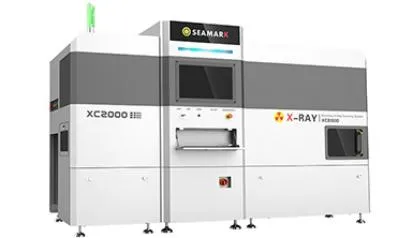
An in line X-ray inspection system becomes relevant when inspection must be integrated directly into production.
Instead of removing samples from the manufacturing process for separate inspection, products can be transferred through an automated inspection station.
A typical workflow may include:
Product Loading → Positioning → X-Ray Imaging → Image Analysis → Result Classification → Production Routing
Seamark states that its inline X-ray inspection equipment can connect directly with production lines for high-capacity automatic inspection.
For high-volume manufacturing, buyers should evaluate more than the imaging system itself. Important factors include conveyor compatibility, product positioning, inspection cycle time, automatic defect recognition, data communication, rejection mechanisms, and system integration.
The objective of inline X-ray automated inspection is not simply to automate image acquisition. It is to create a repeatable inspection process that can operate within the production takt time.
Another important purchasing decision is the imaging architecture.
A 2D X-ray inspection machine produces projection images and can be highly effective for many routine inspection applications.
3D CT systems acquire multiple projections and reconstruct internal structures in three dimensions. They are particularly useful when overlapping structures make 2D interpretation difficult.
Seamark offers industrial microfocus 3D/CT systems for applications including semiconductor packaging, electronic components, and castings.
Manufacturers should therefore ask:
Is 2D information sufficient?
Do internal structures overlap?
Is dimensional analysis required?
Is defect location in three dimensions important?
How much inspection time is available per product?
A 3d X-ray scanner should not automatically be considered better than a 2D system. The correct choice depends on the information required and the economics of the inspection process.
X-ray inspection can also play an important role alongside rework processes.
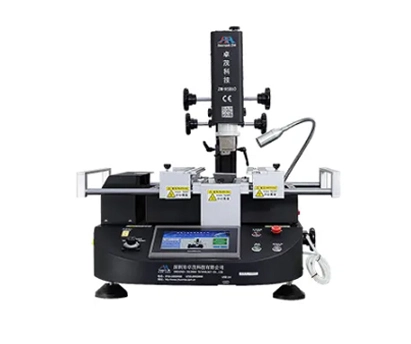
Seamark ZM supplies manual, semi-automatic, and fully automatic BGA rework stations. Its product portfolio also includes microfocus X-ray inspection systems.
In a controlled manufacturing environment, these technologies can serve different functions. A BGA rework station performs component removal, placement, soldering, or repair, while X-ray inspection can be used to examine hidden structures after the process.
This distinction is important when evaluating BGA rework systems. A rework machine should not be treated as an X-ray inspection device, and X-ray inspection should not be considered a substitute for controlled rework procedures.
When comparing X-ray inspection machine price, the lowest initial quotation is not necessarily the lowest total cost.
A professional procurement evaluation should include:
Review X-ray voltage, focal spot, detector resolution, inspection area, magnification, and positioning capability.
Ask the supplier to inspect representative samples. Seamark's FAQ states that customers can send samples for machine testing.
Request certification, radiation-safety information, shielding specifications, interlock documentation, and relevant test reports.
Evaluate image processing, inspection recipes, data storage, defect analysis, and user permissions.
For production applications, verify compatibility with conveyors, loaders, MES interfaces, and automated rejection systems.
Installation, training, maintenance, spare parts, software support, and remote technical assistance should be included in the evaluation.
Seamark ZM has developed a broad range of inspection and electronic manufacturing equipment, including offline and inline microfocus X-ray systems, industrial 3D/CT machines, BGA rework stations, SMD reel counters, and automated optical inspection systems.
Its offline X-ray range includes configurations from 90 kV to 130 kV, with different inspection areas and detector configurations for applications ranging from R&D and small components to semiconductor, LED, and large-board inspection.
This product diversity allows manufacturers to select equipment based on the actual application instead of applying a single configuration to every inspection task.
Selecting an industrial X-ray machine is ultimately a technical, safety, and compliance decision.
Manufacturers need to consider radiation protection, applicable standards, inspection sensitivity, product geometry, automation, software, traceability, and long-term service support alongside the initial equipment cost.
For electronics, semiconductor, casting, and other industrial applications, the right X-ray inspection equipment should provide sufficient technical capability while fitting the manufacturer's quality system and regulatory environment.
With offline, inline, microfocus, and 3D/CT technologies, Seamark ZM provides a range of industrial inspection solutions that can be configured for different manufacturing requirements.
The applicable standards depend on the equipment type and inspection application. IEC 61010-2-091 addresses safety requirements for cabinet X-ray systems, while standards such as ISO 17636-2 apply to digital radiographic testing of welded joints.
Properly designed cabinet X-ray systems use shielding and safety mechanisms to control radiation exposure. Buyers should verify the machine's safety documentation, interlocks, radiation testing, and compliance with local regulations before installation and operation.
Offline systems are generally suitable for laboratories, sampling, R&D, and batch inspection. Inline systems are integrated into production lines and are designed for automated, continuous inspection.
The price varies according to X-ray source, detector, inspection area, automation, imaging technology, software, and customization. A basic 2D system and a fully automated 3D/CT system can have substantially different costs, so price should be evaluated together with application requirements and total ownership cost.
Yes. High-resolution microfocus X-ray systems can be used to examine internal structures in semiconductor packages, bonding areas, and other miniature components. The required resolution and imaging configuration depend on the package and inspection objective.
Yes. X-ray technology can be used for non-destructive examination of castings and can reveal certain internal discontinuities such as porosity and shrinkage. The appropriate system depends on the casting material, thickness, geometry, and required sensitivity.
Provide representative samples, product dimensions, material information, expected defect types, required throughput, inspection area, and whether the system needs to operate offline or inline. Sample testing can help suppliers determine whether a proposed configuration meets the actual inspection requirement.
 EN
EN
 es
es  ko
ko  de
de  it
it  pt
pt  th
th  ar
ar  pl
pl  vi
vi  tr
tr  ru
ru